
Creating Healthy Work Design: A Strategic Advantage for Your Organisation

In a world where burnout, disengagement, and turnover are all too common, one of the most powerful tools a leader has is thoughtful, healthy work design. It’s more than just good management – it’s a protective factor against psychological harm and a springboard for high performance.

At Get Mentally Fit, we support organisations in assessing and redesigning work structures to support mental wellbeing, reduce psychosocial hazards, and boost long-term productivity. Let’s explore how getting healthy work design right can give your business a genuine competitive edge.

Kick things off by watching this video on ‘Systems Thinking’ – health and wellbeing. Then read on…

Why Good Work Design Matters

Be confident: when you get work design right, everyone benefits. It’s not just about avoiding harm. A well-designed role and workplace actively improves employee wellbeing, morale, engagement, and retention.

Importantly, good work design is a national priority in the Australian Work Health and Safety Strategy 2012–22, reinforcing the fact that safe and healthy work environments are integral to economic and social success.

International research backs this up:

  • Better work design protects health and safety: Poorly designed work is linked to increased psychological injury, stress, and absenteeism.
  • It drives performance: Workers with high job satisfaction are up to 31% more productive and three times more creative (HBR, 2015).
  • It supports innovation and adaptability: Teams that feel psychologically safe are more likely to share ideas, take initiative, and improve processes.

What is Healthy Work Design?

Too often, work structures develop organically, without strategic oversight. But when stress, high turnover, or complaints emerge, it’s a sign the design itself may be part of the problem.

Healthy work design means structuring tasks, environments, and roles to:

  • Minimise foreseeable risks to mental and physical health
  • Promote wellbeing and satisfaction
  • Enable high performance without harmful strain

Safe Work Australia outlines essential components of good design:

  • Smooth workflows supported by the right tools
  • Ergonomic workstations and reasonable demands
  • Clear, respectful communication and role clarity
  • Autonomy, fairness, and achievable targets
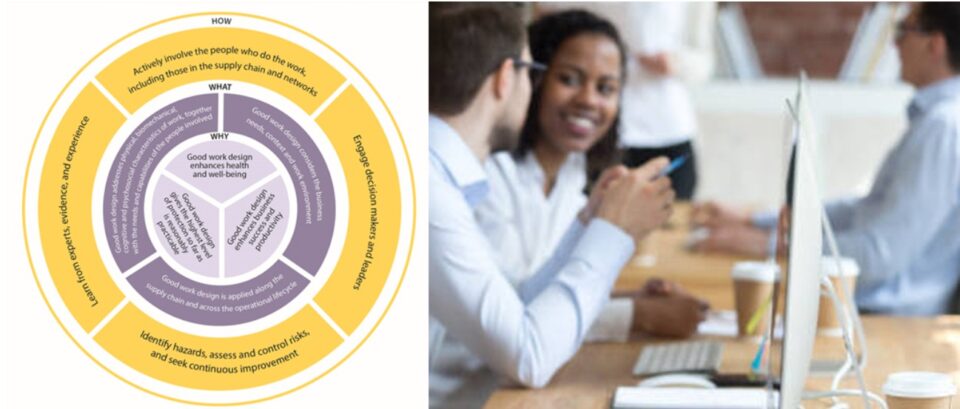
Diagram illustrating the key elements of good work design, including role clarity, autonomy, social support, and manageable demands.
This work design diagram highlights the core features of a mentally healthy job—clarity, autonomy, support, and manageable demands—critical for wellbeing and performance.

The Healthy Work Design Process

Creating healthy work isn’t a one-off task. It’s a continuous improvement process that requires reflection, consultation, and leadership.

Here’s a practical four-stage approach:

1. Understand the Context

Start by identifying:

  • The nature and location of the work
  • The composition and capabilities of your workforce
  • The limitations or risks in the physical environment
  • Gaps between documented procedures and how work is actually done

2. Analyse Task Demands and Resources

Look at the job demands across several dimensions:

  • Physical (e.g. manual handling, exposure to hazards)
  • Mental (e.g. complexity, concentration, time pressure)
  • Emotional (e.g. managing distressed clients, emotional labour)
  • Psychosocial (e.g. autonomy, feedback, interpersonal dynamics)

Match the demands with appropriate resources, support, and capabilities.

3. Design and Implement Tailored Solutions

Bring together a cross-section of your organisation – leaders, HR, frontline staff – to co-design improvements. These might include:

  • Rebalancing workloads
  • Enhancing autonomy and role clarity
  • Improving processes or task scheduling
  • Introducing new tools or support systems

4. Review and Iterate Continuously

Good work design requires consistent evaluation:

  • Monitor psychological safety and performance indicators
  • Collect feedback through surveys, check-ins, or forums
  • Adjust and evolve systems as roles or teams change

Final Thoughts: Build a Workplace That Works

Healthy work design isn’t a luxury – it’s a strategic necessity. It protects mental health, enhances job satisfaction, and future-proofs your business.

If you’re noticing signs of strain in your team – increased sick days, disengagement, or turnover – it might be time to review your workplace design.

✅ Ready to Strengthen Your Work Environment?

At Get Mentally Fit, we help leaders design and implement high functioning, mentally healthy, work environments tailored to their organisation’s unique needs.

📞 Get in Touch with one of our leading workplace psychologists 📥 and explore our suite of Workshops or Organisational Development services.

Let’s create a workplace where people feel supported, capable, and ready to perform at their best.

More articles

An overhead close-up shot of multiple hands working collaboratively around a wooden table to fit together large interlocking gears made of light natural wood, bright yellow, and vibrant pink.
Staff Harmony: The Case for External Psychological Intervention
The Hidden Fuse: Why Internal Workplace Conflict Resolution Fails By the time an interpersonal conflict or role dispute lands on…

A professional double-exposure photograph combining a business meeting and a scene of personal life. The dominant image shows corporate professionals working together around a light wooden conference table with a man in a navy blazer pointing at a document. Seamlessly blended over the right side is a translucent silhouette of a family - a parent and two young children - running joyfully along a sunny beach, representing work-life integration.
Employee Value Proposition: Success from the Inside-Out
More than a talent attraction tool In today’s ever-evolving world of work, a thoughtful, well-articulated Employee Value Proposition (EVP) is…
A vibrant line of ten monochrome LEGO minifigures arranged in a spectrum of rainbow colors against matching vertical stripes. In the foreground, an orange minifigure stands out slightly out of line, while a blue minifigure near the center steps forward, symbolising individuality, diversity, and shifting dynamics within a structured group.
How to Assess Psychosocial Risks: A Practical Guide for SMEs
Assessing Psychosocial Risks: A Guide for Modern Leaders In today’s fast-paced business environment, assessing psychosocial risks isn't just a legal…