I Really Want to Make a New Habit Stick

Firstly, cut yourself some slack – we’ve got you on this.

You made a commitment to change something important in your life. Maybe it was to get fitter, sleep better, spend more time with family, or finally start journaling. You might have even shared this resolution with friends or loved ones, with the goal of celebrating your success in a few months.

That sense of accomplishment? It’s still absolutely within reach. But if you’re here, chances are your motivation has already started to fade – and you’re wondering how to actually get momentum.

Good news: The problem isn’t you. It’s the approach.

Let’s explore a practical, neuroscience-backed strategy to help you make your new habit stick – without relying on willpower alone.

Let’s Get Stuck Into Habit Stacking

What is ‘Habit Stacking’?

Habit stacking is a simple yet powerful technique that helps you build new habits by attaching them to existing ones. It’s part of a broader behavioural science approach made popular by BJ Fogg, author of Tiny Habits: The Small Changes That Change Everything, and founder of Stanford’s Behaviour Design Lab.

As Fogg says:

“No behaviour happens without a prompt.”

In other words, the key to starting and sticking with a new habit is to link it to something you’re already doing regularly – your anchor habit.
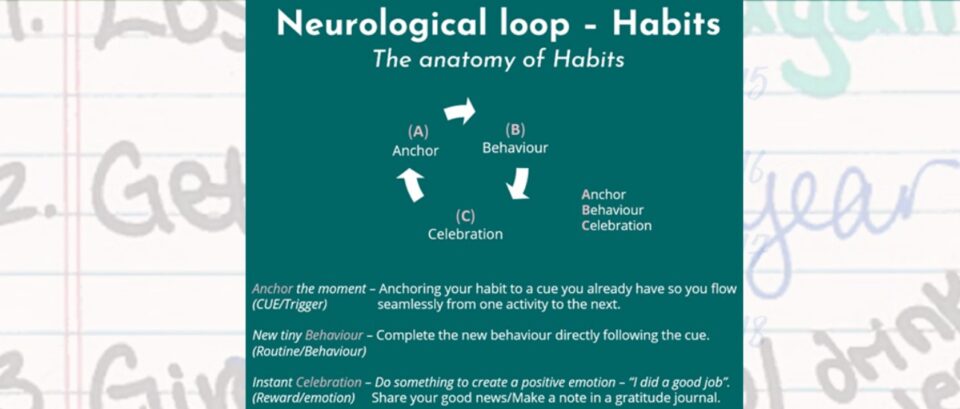
Diagram illustrating the anatomy of habits, showing the cue, routine, and reward cycle that forms the habit loop.
This habit anatomy diagram breaks down the core components of behaviour change—cue, routine, and reward—offering a visual guide to building habits that stick.

How It Works

Fogg’s model for habit formation includes three steps:
Anchor → New behaviour → Celebration

Let’s break that down:

  • Anchor (Cue): A habit you already do, like brushing your teeth or making coffee.

  • New Behaviour: The tiny habit you want to start.

  • Celebration: A small positive action that reinforces the habit (like a fist pump or saying “nailed it!”).

For example:

After I make my morning coffee, I will do two push-ups. Then I’ll say, “I’m getting stronger!”

By embedding your habit into an existing routine, you reduce the need for motivation and memory – which are both limited resources.

⚠️ Beware the Gung-Ho Trap

Most failed resolutions start with too much ambition and too little structure.

You know the drill:

“I’ll do 20 push-ups a day, 3 days a week!”

The first week feels great. By week three? You’re sore, swamped with work, and skipping workouts. Soon, the habit disappears altogether.

Why? Because it wasn’t tiny enough to stick.

✅ Try the ‘Tiny Habit’ Approach Instead

Start small. Ridiculously small.

Instead of 20 push-ups, start with 2.

When that becomes second nature, you can build up. This works because it removes the pressure to perform and lets your brain associate the habit with ease and reward, not struggle and failure.

And yes – you can increase the intensity over time. But starting tiny gets you started at all.

🧩 The Tiny Habit Recipe

Use this template to start building new behaviours into your day:
“After I [current habit], I will [new tiny habit]. Then I’ll [celebrate].”

Here are a few ideas:

  • After I sit up in bed, I will stretch for 10 seconds.

  • After I put the toothbrush in my mouth, I will do 2 squats.

  • After I hang up the phone, I will walk around the room.

  • After I sit down to eat, I will ask my child what the best part of their day was.

Pro tip: The celebration is key – it rewires your brain to associate the new behaviour with a positive emotion.

O.K… it’s your turn to try it! Use the recipe card below to help you.
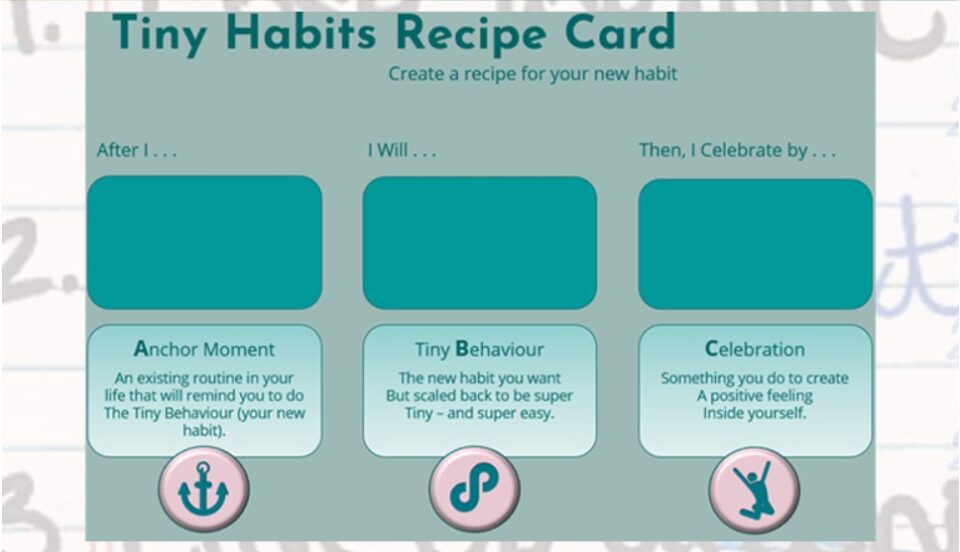
Diagram of the Tiny Habits Recipe Card, outlining a simple formula for building new habits through small, consistent actions.
The Tiny Habits Recipe Card provides a proven, step-by-step method to embed new behaviours by anchoring them to existing routines and celebrating success.

🧠 The Psychology Behind It

Why does this work?

Because it bypasses the need for motivation and taps into your brain’s reward system. By keeping the habit small, consistent, and positive, you train your brain to crave the behaviour.

Research from Stanford and other behaviour change studies shows that:

  • Context beats motivation. Anchoring your habit makes it easier to remember and act on.

  • Emotion drives repetition. Celebrating immediately after makes the habit emotionally rewarding.

  • Small wins add up. Tiny changes compound over time into meaningful transformation.


😬 What If I Still Fail?

Then you’re human.

Don’t abandon your goals – adjust your strategy. Ask yourself:

  • Was the anchor too weak?

  • Was the new behaviour still too ambitious?

  • Did I forget to celebrate?

Remember, failure is feedback. A growth mindset lets you tweak the system until it works for you.

Here’s some simple examples to help you out

After I… sit up in bed… I will… stretch for 10 seconds

After I… put the toothbrush in my mouth… I will… complete 2 squats

After I… hang up the phone… I will… get up and walk around the room for two minutes

After I… sit down to eat… I will… ask my children to tell me about the best part of their day

📣 Want Support to Build Your Mental Fitness?

At Get Mentally Fit, we help individuals and organisations build sustainable behaviours that improve psychosocial wellbeing, performance, resilience, and success.

💬 Whether you’re forming habits for personal growth or aiming to build mental fitness in your team, we can help.

🔗 Get in Touch Today or explore our Training Workshops for supporting the capabilities of your people.

📬 Join our mentally fit community below or follow us on socials for weekly wellbeing tips and habit-building insights.

You don’t need to rely on willpower. You just need the right system.

Let’s build habits that last – together. 💪

More articles

An overhead close-up shot of multiple hands working collaboratively around a wooden table to fit together large interlocking gears made of light natural wood, bright yellow, and vibrant pink.
Staff Harmony: The Case for External Psychological Intervention
The Hidden Fuse: Why Internal Workplace Conflict Resolution Fails By the time an interpersonal conflict or role dispute lands on…
A professional double-exposure photograph combining a business meeting and a scene of personal life. The dominant image shows corporate professionals working together around a light wooden conference table with a man in a navy blazer pointing at a document. Seamlessly blended over the right side is a translucent silhouette of a family - a parent and two young children - running joyfully along a sunny beach, representing work-life integration.
Employee Value Proposition: Success from the Inside-Out
More than a talent attraction tool In today’s ever-evolving world of work, a thoughtful, well-articulated Employee Value Proposition (EVP) is…
A vibrant line of ten monochrome LEGO minifigures arranged in a spectrum of rainbow colors against matching vertical stripes. In the foreground, an orange minifigure stands out slightly out of line, while a blue minifigure near the center steps forward, symbolising individuality, diversity, and shifting dynamics within a structured group.
How to Assess Psychosocial Risks: A Practical Guide for SMEs
Assessing Psychosocial Risks: A Guide for Modern Leaders In today’s fast-paced business environment, assessing psychosocial risks isn't just a legal…